 Yarrow
is one of those plants that people either love or hate. Another of
the many members of the Aster family, Yarrow is easy to grow, is quite cold
hardy, has nice feathery foliage and big, flat flower heads that bloom for
a longer period than most perennials in yellows, whites, pinks and reds.
In my humble opinion, Yarrow can be a nice addition to most gardening scenarios,
with a few notable exceptions.
Yarrow
is one of those plants that people either love or hate. Another of
the many members of the Aster family, Yarrow is easy to grow, is quite cold
hardy, has nice feathery foliage and big, flat flower heads that bloom for
a longer period than most perennials in yellows, whites, pinks and reds.
In my humble opinion, Yarrow can be a nice addition to most gardening scenarios,
with a few notable exceptions.
 As
with other easy to grow, sturdy plants that sprout easily from seed and
also spread underground, Yarrow can become quite invasive if it likes its
situation, especially in sunny meadows or disturbed areas. Therefore,
if you live near a natural meadow or are in a farm-type situation,
you probably shouldn't plant Yarrow anywhere nearby, because if it takes
hold, there will be no stopping it. However, in most home gardens where
the gardener is on duty, this type of invasiveness shouldn't occur, unless
the garden is abandoned for a long period of time. I have grown Yarrow
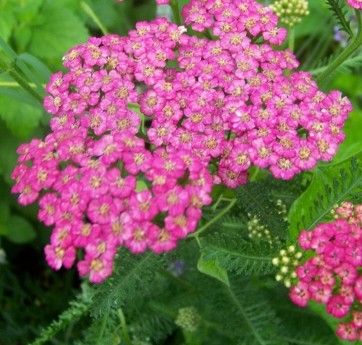
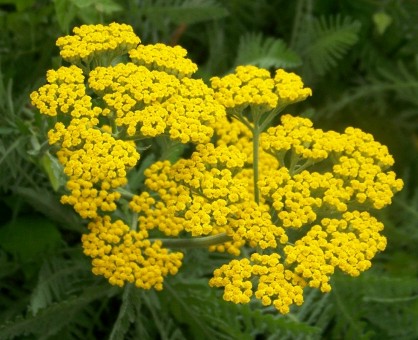
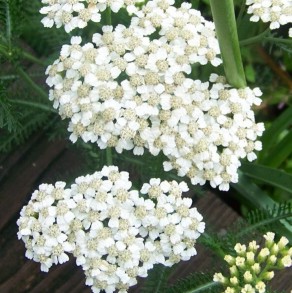
(Achilles Millefolium pictured above and below) in my garden for years.
The plants have come back year after year reliably and though the plants
themselves are a bit bigger than they were originally, I have noticed very
little spread. I like the ferny foliage and airy look of the flowers
in late spring/early summer. Some gardeners complain that the white
flowers look "dirty," and indeed they do when they start to decline, but
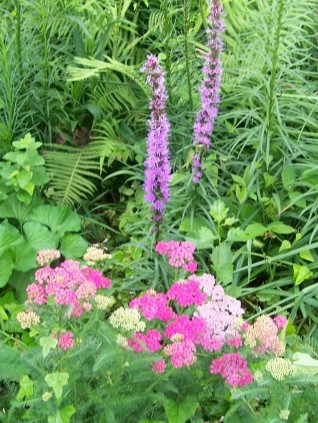
these can be deadheaded to keep the scene crisp and fresh-looking. The picture
below is an example of how Yarrow looks planted densely with ferns and other
flowering plants and herbs nearby.
As
with other easy to grow, sturdy plants that sprout easily from seed and
also spread underground, Yarrow can become quite invasive if it likes its
situation, especially in sunny meadows or disturbed areas. Therefore,
if you live near a natural meadow or are in a farm-type situation,
you probably shouldn't plant Yarrow anywhere nearby, because if it takes
hold, there will be no stopping it. However, in most home gardens where
the gardener is on duty, this type of invasiveness shouldn't occur, unless
the garden is abandoned for a long period of time. I have grown Yarrow
(Achilles Millefolium pictured above and below) in my garden for years.
The plants have come back year after year reliably and though the plants
themselves are a bit bigger than they were originally, I have noticed very
little spread. I like the ferny foliage and airy look of the flowers
in late spring/early summer. Some gardeners complain that the white
flowers look "dirty," and indeed they do when they start to decline, but
these can be deadheaded to keep the scene crisp and fresh-looking. The picture
below is an example of how Yarrow looks planted densely with ferns and other
flowering plants and herbs nearby.
 Yarrow
is also a fairly valuable medicinal herb that has been used for centuries,
and as such makes a nice flowering addition to the herb garden, where it
appears to benefit other herbs as far as enhancing production of their essential
oils. It attracts beneficial insects including ladybugs, syrphid flies,
tachinid flies, and parasitic wasps, helping to keep unwanted pests such
as aphids in check in the garden.
Yarrow
is also a fairly valuable medicinal herb that has been used for centuries,
and as such makes a nice flowering addition to the herb garden, where it
appears to benefit other herbs as far as enhancing production of their essential
oils. It attracts beneficial insects including ladybugs, syrphid flies,
tachinid flies, and parasitic wasps, helping to keep unwanted pests such
as aphids in check in the garden.
Yarrow is an undemanding plant that grows easily from seed, but as with
many perennials, it will probably not bloom the first year unless started
indoors in late fall or early winter. It is quite cold tolerant and is hardy
to zone 3. It does not like extremely humid climates, and most varieties
don't do well past zone 8. It is not picky about soil and can withstand
long periods of drought once established. It is picky about full or
nearly full sun and about well-drained soil, though the soil does not have
to be particularly rich. In fact, too rich a soil, too much watering, or
too much shade will cause the plant to be less sturdy overall.
 As
far as maintenance, I prefer to keep the flowers deadheaded for looks and
for bloom that lasts a bit longer. After the spring/early summer blooms
are done, cut the plants down almost to the ground and they will grow back
for another show in the fall.
As
far as maintenance, I prefer to keep the flowers deadheaded for looks and
for bloom that lasts a bit longer. After the spring/early summer blooms
are done, cut the plants down almost to the ground and they will grow back
for another show in the fall.
Yarrow makes a nice addition to cut flower vases and dried flower arrangements.
For harvesting, cut flower stalks when about half the flowers in the cluster
have opened and before any have started to fade. Strip all the leaves before
adding to the arrangement (note that the leaves have a nice smell).
If you want to keep the Yarrow for dried flower arrangements, just let them
sit in the same vase without water until they are completely dry.
Alternatively, you can obviously hang the stripped stems upside down
in a cool, well-ventilated place until dry. Either way works equally
well.
 Yarrow
has a sweet but slightly bitter taste and is generally safe for ingestion.
Please see the Medicinal and Recipe sections at the top of the page for
further information.
Yarrow
has a sweet but slightly bitter taste and is generally safe for ingestion.
Please see the Medicinal and Recipe sections at the top of the page for
further information.
Yarrow seeds are tiny, and
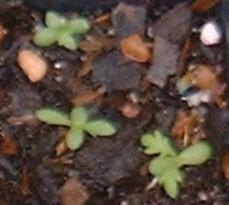
tiny seedlings sprouted for me in about 4 days with picture here at about 2 weeks.
