Gardens Ablaze

St. John's Wort
Wisdom is oftentimes nearer when we stoop than when we soar.
William Wordsworth, 1798

Shop BHG 50% Off

| Herbs Index | Herbal Remedy Chart |
|
Home | Annuals | Architectural Elements | Backyard Habitat | Biennials | Bonsai | Bulbs | Cactus/Xeriscaping | Companions |
| Composting | Container Gardening |
Crafts | Garden Ornamentation | Gargoyles | Greenhouses | Ground Covers |
| Insects/Diseases | Landscaping | Organics |
PerennialsPonds | Propagation | Recipes | Roses | Seeds |
| Shade Gardens | Shrubs/Hedges | Tools | | Trees |
Vegetables | Vines | Weeds | Wildflowers | Wildlife | Shop |

Additional St. John's Wort Information

Medicinal Uses
Magic & Superstition


St. John's Wort Herb C/S (Hypericum perforatum) 1 lb: C

Things You Never Knew Existed...where the UNUSUAL is usual!

 Translate your creative spirit outdoors. Our highest quality grande fountains & garden masterworks from Design Toscano now up to 50% OFF

Baron Bob and Wonderfully Wacky - presents possibly the world's wackiest gift gallery surf by & decide for yourself!

EngravingShop.com Personalized Gifts, Wedding Accessories and Awards!

HOME 3

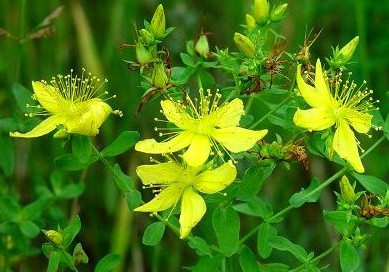
St. John's Wort is a hardy perennial that grows wild all over the world.  It has the peculiar property of "bleeding" when the flowers are pinched, and because of this, it has been linked extensively to magical lore and witchcraft.  The leaves and stems also contain red sap, but it is not as bright red as the sap from the flowers.  The plant showed a decline in popularity as a medicinal herb earlier in this century, but there has been a recent resurgence of interest in it, largely due to it's properties as a potential anti-depressant.  It has no real uses as a culinary herb because of it's bitter taste, but small amounts of the leaf can be used in green salads if so desired.

St. John's Wort is a short, bushy plant with bright yellow flowers that add color to the garden in mid-summer when many of the other flowers are hiding from the heat.  It is not particular about soil conditions and is found growing wild in dry soils in areas with full sun.  It has a turpentine-like smell, and bluish-green leaves.  It grows to a height of about 3 feet, and the roots send out runners, making it an opportunistic plant that has spread all over the world.  The leaves have transparent oil glands that can be seen by holding a leaf up to the light.  The numerous seeds are contained in three-celled capsules, and are black.  

St. John's Wort can be propagated by seed, stem cuttings, or root division (in the fall).  Although it is a hardy perennial (to zone 5), it is a rather short-lived plant as far as perennials go, and will have to be replaced periodically. 

Message Board

Gardens Ablaze Home


GiftTree Holiday Catalog, Christmas Gifts

Gardens Ablaze

Outlet

E-Mail      Home     Link To Us     Shop