|
Gardens Ablaze |
||
|
|
Angelica |
|
|
Additional Angelica Information
Medicinal Uses Site Map
Home |
 Angelica
is one of the herbs that is difficult to peg as a either biennial or perennial.
It definitely does not fit into the annual category, because it won't flower,
seed, and die until the second or third year (which would indicate biennial).
If flowering is thwarted, however, the plant can survive for many years
(suggestive of a perennial). Therefore, it is something of a perennial
biennial, and will be listed as both on this page, since even the botanists
are not in agreement on this issue. Angelica
is one of the herbs that is difficult to peg as a either biennial or perennial.
It definitely does not fit into the annual category, because it won't flower,
seed, and die until the second or third year (which would indicate biennial).
If flowering is thwarted, however, the plant can survive for many years
(suggestive of a perennial). Therefore, it is something of a perennial
biennial, and will be listed as both on this page, since even the botanists
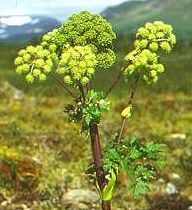
are not in agreement on this issue. Angelica is a tall plant (up to 8 feet in some cases), so take this into consideration when placing it in the herb garden. The roots are long, thick, and fleshy. It has bright green, fine leaves and is an attractive plant, that somewhat resembles celery. It has an pervading, aromatic smell somewhat similar to celery, but that some liken more to musk, and others liken more to the smell of Juniper. It has a licorice taste, evident in the entire plant, from roots to seed. The root has a slightly bolder taste than the seeds, and combines well in yeast breads, cakes, muffins, and cookies (press it into the dough before baking). Then glaze or finish in whatever manner you choose. The stems can be candied for a unique, little known treat, and can be used to decorate cakes or puddings. The leaves can be used fresh in salads, soups, stews, or as a garnish. Both the roots and seeds are used commercially to flavor herb liqueurs, such as Benedictine and chartreuse, and the root is a flavoring agent in gin and vermouth. Angelica should be started from seed. It does not propagate well by division or by cutting the offshoots. It prefers rich, moist, well drained soil and partial shade. The leaves can be harvested in the spring of the second year, the roots in the fall of the first year, and the seeds when ripe.

Custom Search
|
|
|
Gardens Ablaze |
||